Consider the Cuisinart GR-11NAS when a measured storage spot, its documented cover formats, and a removable-part care routine solve a real sandwich problem. Keep your current method when the appliance would add another storage or cleaning step.
- Evidence
- 3 cited sources
- Decision checks
- 6 before-buying checks
- Model set
- 1 exact model
- Testing basis
- Published-source review
Start with the sandwich routine
A compact panini press earns consideration when it changes a specific sandwich routine. Begin with the meal you actually make: a pressed lunch, a grilled open-face meal, or a weekend sandwich that currently needs a pan, a second pan, or a crowded oven. The question is whether a dedicated appliance removes a recurring inconvenience, not whether the word compact sounds reassuring.
Write the routine in order before looking at a listing. Note where bread and fillings are staged, where the finished sandwich lands, and where the appliance will live between uses. If the answer depends on clearing a shelf every time or balancing a hot tool beside the sink, record that friction. A purchase decision is clearer when the space and care work are visible.
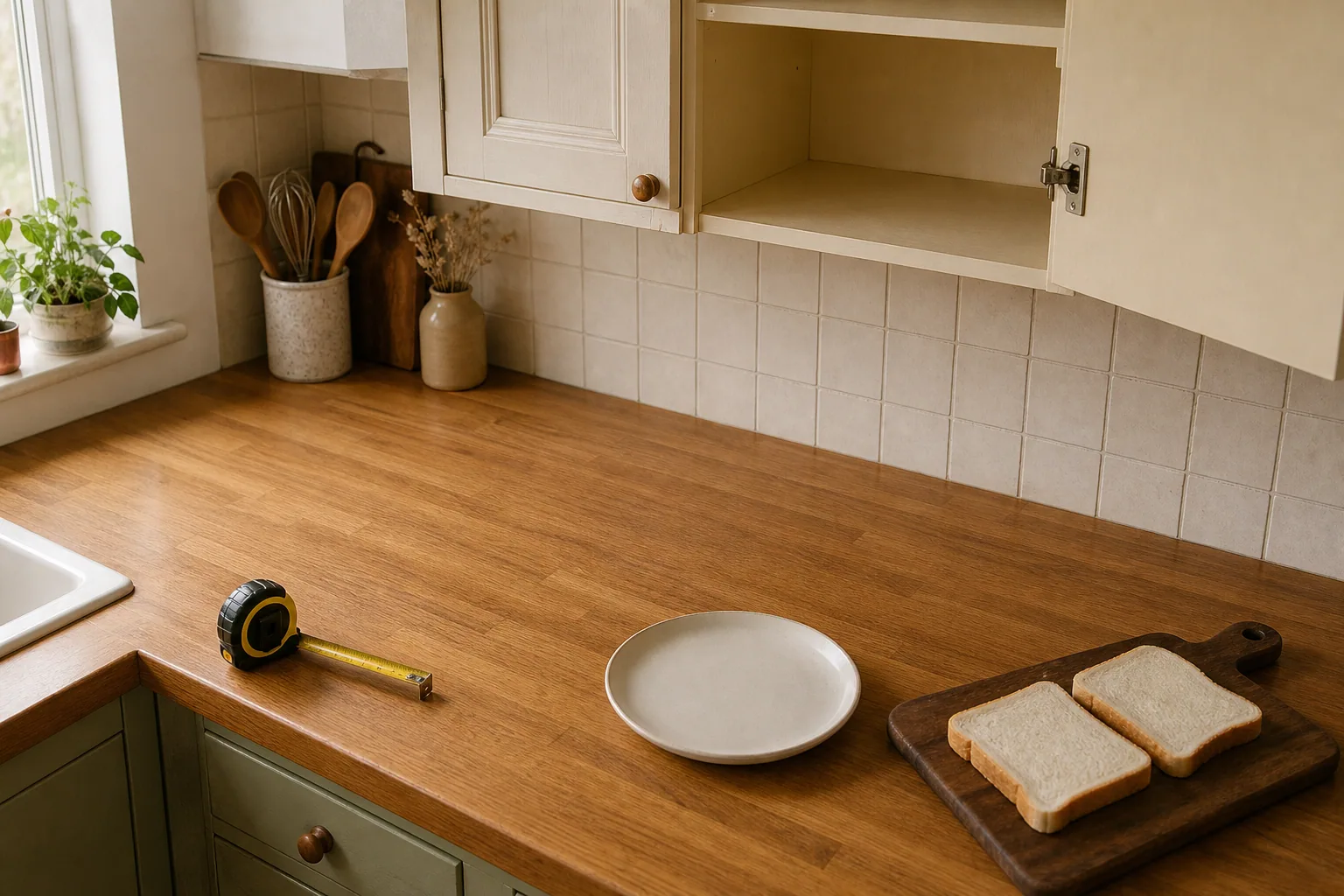
Measure the maker-listed body envelope
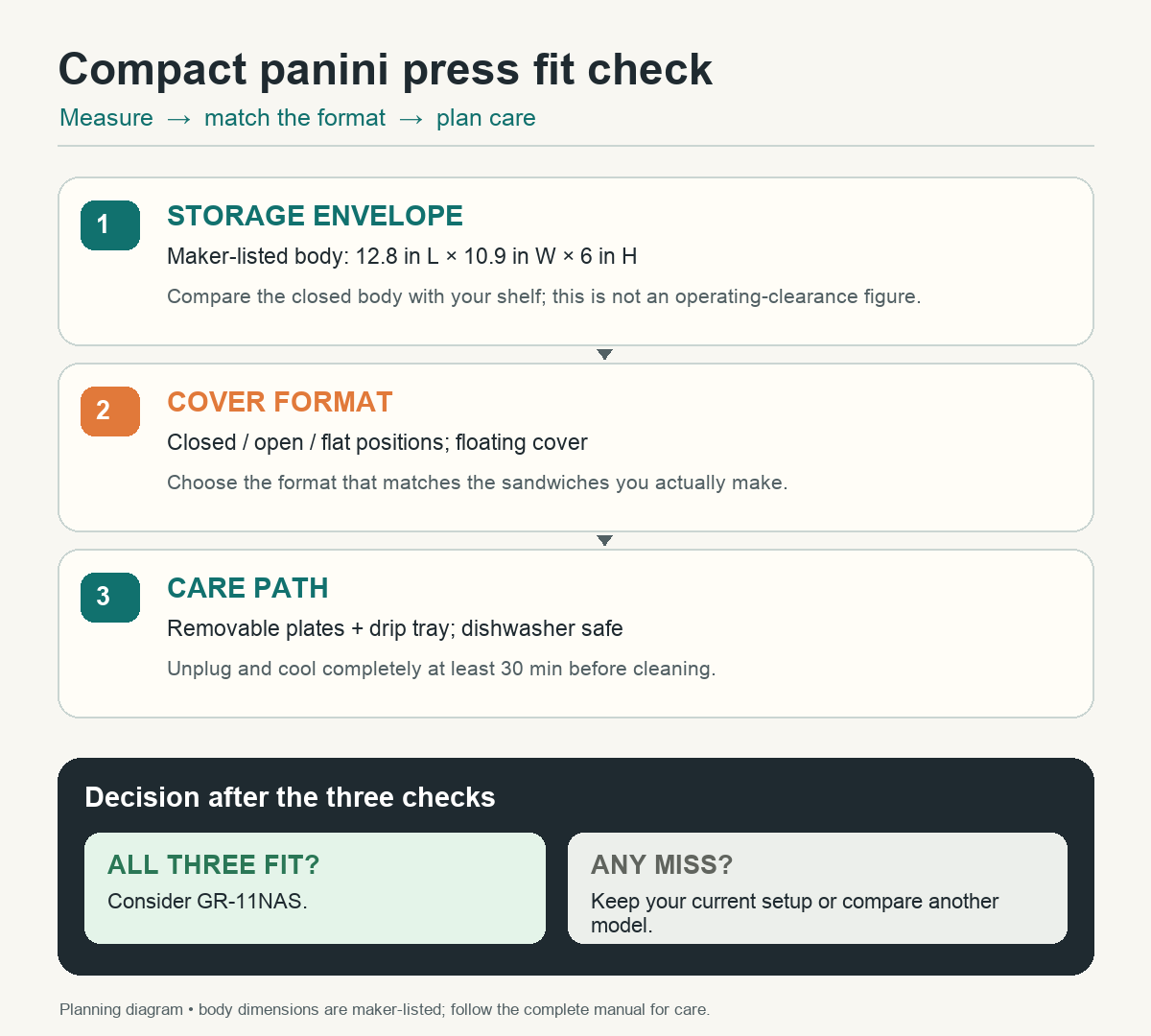
Cuisinart lists the GR-11NAS at 12.8 in L × 10.9 in W × 6 in H. Treat that as the maker-listed product envelope for a storage check. It is not an operating-clearance measurement, so do not turn the three numbers into a promise that the unit can run in a particular cabinet or against a particular wall.
Measure the closed storage spot, then trace the route to the surface where bread will be placed. Check the narrowest turn, the door or lid movement, and the landing area for a plate. Storage can work while the working path fails; those are separate questions and should be measured separately.
- Storage: where will the closed unit live between uses?
- Work path: where can the cover open without moving another tool?
- Landing spot: where will the sandwich and removable parts go during the routine?
Check whether the cover format matches
The official product page identifies the GR-11NAS as a contact grill, panini press, and full grill. It also lists a hinged floating cover, a flat opening, and removable ceramic-nonstick plates. Those are documented formats and design features; they do not establish how evenly food browns or how much a serving can hold.
The GR-11 Series manual describes closed, open, and flat positions and an adjustable panini handle for food thickness. Translate that into a choice about your own routine: do you need a closed press, an open surface, or the option to lay the unit flat? More positions only help when one of them replaces a step you already find inconvenient.
Make cleanup part of the purchase decision
The manual says the grill plates and drip tray are removable and dishwasher safe. It also says to unplug the unit and let it cool completely for at least 30 minutes before cleaning; its care guidance excludes metal utensils and scouring pads. These instructions define a care path, not a claim about how easy cleanup will feel in every kitchen.
Plan that path before ordering. Decide where the unplugged unit can rest, whether the removable pieces have a dishwasher or hand-cleaning place, and where they will dry before storage. A care routine that blocks the only prep surface may erase the space benefit even when the closed body fits.
- After use: reserve a safe resting place for the unplugged unit.
- Parts: choose the dishwasher or hand-cleaning route before the first meal.
- Storage: give the plates, tray, and cord a repeatable home.
Choose the exact model only if the worksheet passes
The Cuisinart GR-11NAS is listed as the New Version- Griddler option under ASIN B0FLSKNGV2. Treat the model and selected option as part of the decision: a general “panini press” result is not enough when the fit judgment depends on the GR-11NAS documentation above.
Consider this model when the measured storage spot, a usable cover format, and the planned care path all line up with a real sandwich habit. Keep the method you already have when one of those conditions fails or when the press would be an occasional extra task. Confirm that the listing still shows the selected model before ordering.
The exact model and its limits
Use the verified facts and limits below to decide whether this model fits your routine.
Best for: Consider it when a measured home and care path fit your sandwich routine.
Cuisinart Griddler Grill & Panini Press
The GR-11NAS fits readers who can name a sandwich routine, measure the stored body and working path, and keep a repeatable care place. Keep another method when the routine or storage path does not fit.
Verified facts- Cuisinart identifies the selected item as model GR-11NAS.
- The GR-11 Series manual documents removable dishwasher-safe plates and drip tray plus closed, open, and flat positions.
- The retail listing for this assessment identifies ASIN B0FLSKNGV2.
- The maker-listed dimensions describe the product envelope, not operating clearance.
- This guide makes no taste, browning, capacity, speed, durability, or hands-on performance claim.
- Storage and care fit depend on the reader’s space and routine.
- Use the complete GR-11 manual for operation and cleaning.
Paid link — I may earn a commission from a qualifying purchase. No price or rating is stored here.
Before-you-buy checklist
- Name the sandwich routine this appliance would change.
- Measure the closed storage spot and the working path separately.
- Decide whether closed, open, or flat use matters to your routine.
- Reserve a landing place for the unit and removable parts.
- Choose a repeatable care and storage route before ordering.
- Keep your current method when no single constraint improves.
Sources and verification
Sources support the measurement method and examples above. Product-specific recommendations require a current manufacturer page or manual for that exact model.
- Primary: Cuisinart GR-11NAS product pageCuisinart
- Primary: Cuisinart GR-11 Series instruction bookletCuisinart
- Cuisinart Griddler Grill & Panini PressAmazon verified affiliate listing