Start with BLACK+DECKER only when its maker-labeled 11.2-inch length clears the plug and door path. Use Breville when low closed height matters more than depth. Treat Panasonic as evidence-incomplete until current exterior dimensions and model-specific clearances are confirmed.
- Evidence
- 6 cited sources
- Decision checks
- 7 before-buying checks
- Model set
- 3 exact models, not a ranking
- Testing basis
- Published-source review
The old size line is now the expensive mistake
A shallow counter punishes a confident measurement that came from the wrong date. The existing guide carried exterior numbers for Panasonic and an older depth for Breville. On September 1, 2026, the registered manufacturer pages no longer supported that Panasonic size, while Breville's current page reported a different closed depth. That source drift is the reason for this refresh: an apparently tidy specification table could now send a reader toward the wrong cardboard template.
The direct answer is conditional. BLACK+DECKER is the first model to check when the maker-labeled 11.2-inch length is the hard front-to-back constraint. Breville becomes the more relevant comparison when low closed height and room for an 11-inch pizza matter more than depth. Panasonic still has a useful door-connected rack and compact-capacity story, but its current official page does not publish the exterior dimensions needed for a responsible tight-counter recommendation.
None of those choices is ready from the closed body alone. The counter must also carry the plug route, any handle projection, the full door movement, standing room, manufacturer-required ventilation, and a heat-safe place for the pan. If one of those zones is unknown, the result is not a fit. It is a model that needs another measurement or a different location before the purchase link becomes useful.
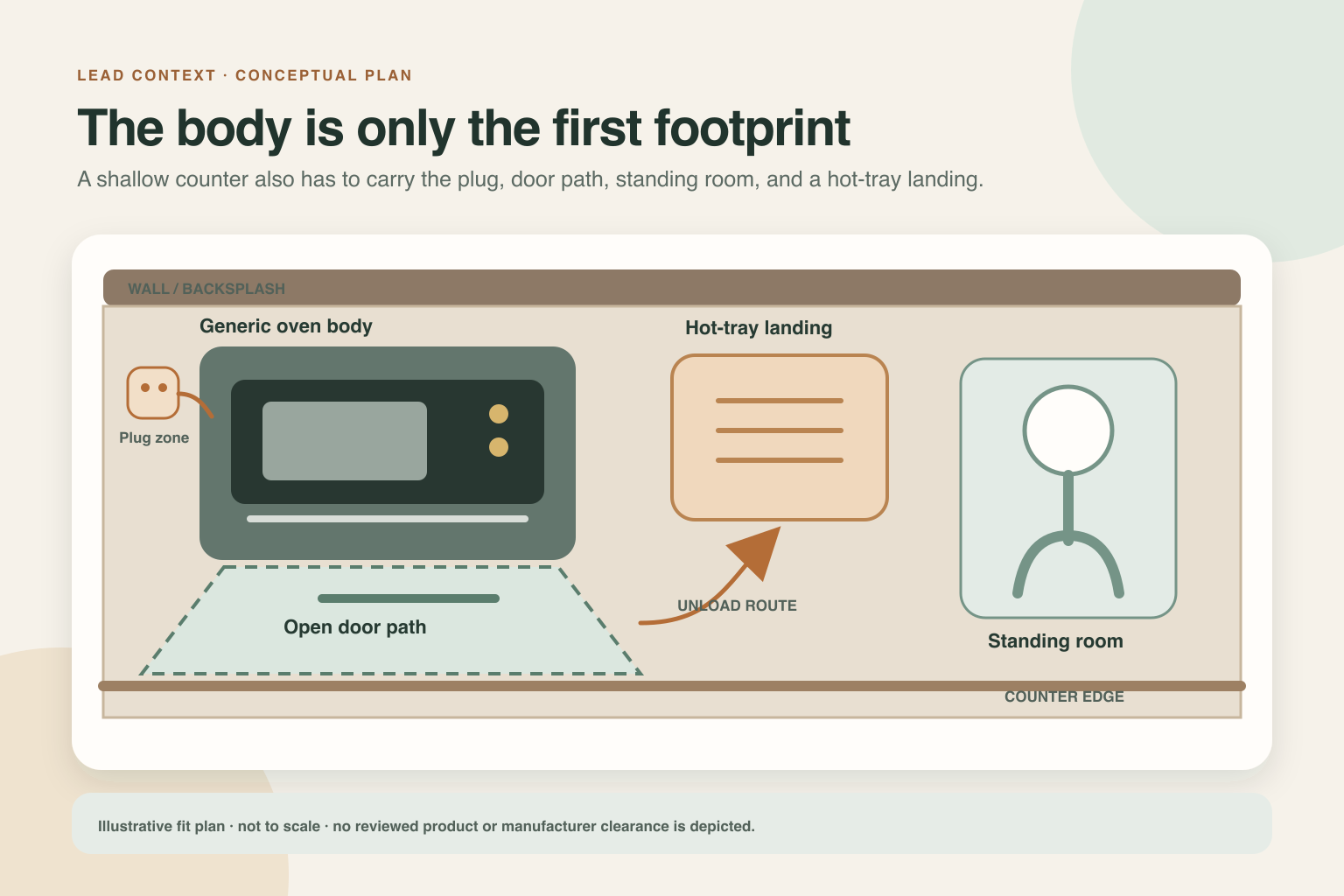
Measure four zones before comparing cooking features
Begin with the rectangle that is actually usable, not the full stone slab. A backsplash lip, rounded front edge, outlet body, neighboring appliance, or cabinet side panel can reduce the parking area. Mark that closed-body rectangle on paper, then add the cord and plug route as a separate shape. A plug forced against the wall can move the entire appliance forward even when the catalog number looked safe.
Next, trace movement. A drop-down door turns the appliance into a larger temporary footprint, and a rack or tray can extend farther toward the cook. Panasonic documents a rack connected to the door, which helps explain the access motion but does not supply a numerical open-door measurement. The honest check is a door-path zone that stays unapproved until the exact model can be measured or documented.
Finally, reserve a landing surface and a clearance envelope. The landing surface must remain available while food is being prepared; a cutting board that has to disappear every time the oven opens is a workflow conflict. Clearance is a different question again. A marketing photo under an upper cabinet cannot replace model-specific instructions, so an unpublished rear, side, or overhead requirement stays visibly unknown rather than being copied from another oven.
- Draw the closed body, plug, and handle as separate boundaries.
- Trace the door, rack, and pan route through the full opening motion.
- Keep one heat-safe unloading surface outside the appliance footprint.
- Apply clearance only from documentation for the exact model.
- Reject any location that pushes the open door into the main walkway.
The current maker facts split the shortlist three ways
BLACK+DECKER is the depth-led baseline because its current page labels the TO1313SBD as 15.5 inches wide, 11.2 inches long, and 8.3 inches high. The same page describes capacity for four slices or a 9-inch pizza. That makes 11.2 inches the shortest maker-labeled front-to-back figure in this set, not a promise of installed depth. Choose it only if the separate handle, plug, door, landing, and clearance checks also pass. Its width can still eliminate it from a narrow strip of counter.
Breville is the height-and-capacity alternative. Its current BOV450XL page lists 16 inches wide, 13.6 inches deep, and 8.8 inches high, plus four-slice or 11-inch-pizza capacity and 1800 W power. The low closed body is the reason to compare it beneath a low cabinet, but that cabinet does not become an approved location merely because the body fits underneath. Breville also asks for the most published width and depth in this set, so it can protect vertical room while consuming the unloading area beside it.
Panasonic is now the evidence-incomplete branch. The current NB-G110P page confirms 1300 W power, four slices or a personal pizza, and a baking rack connected to the door. It does not publish the exterior dimensions or the model-specific clearance needed for this exact question. That means an old width or depth cannot be promoted as a current fact. Keep Panasonic on the research list when the door-linked rack is appealing, but do not rank it as the narrow-body winner until a dated official source supplies the missing envelope.
These three models remain the comparison universe because each has an exact Amazon landing and a current registered maker page. Larger air-fryer ovens were excluded because their capacity-first design changes the fit question, and an unrelated coffee maker was excluded because it belongs to another appliance class. Adding either group would increase product count without clarifying the reader's shallow-counter decision.
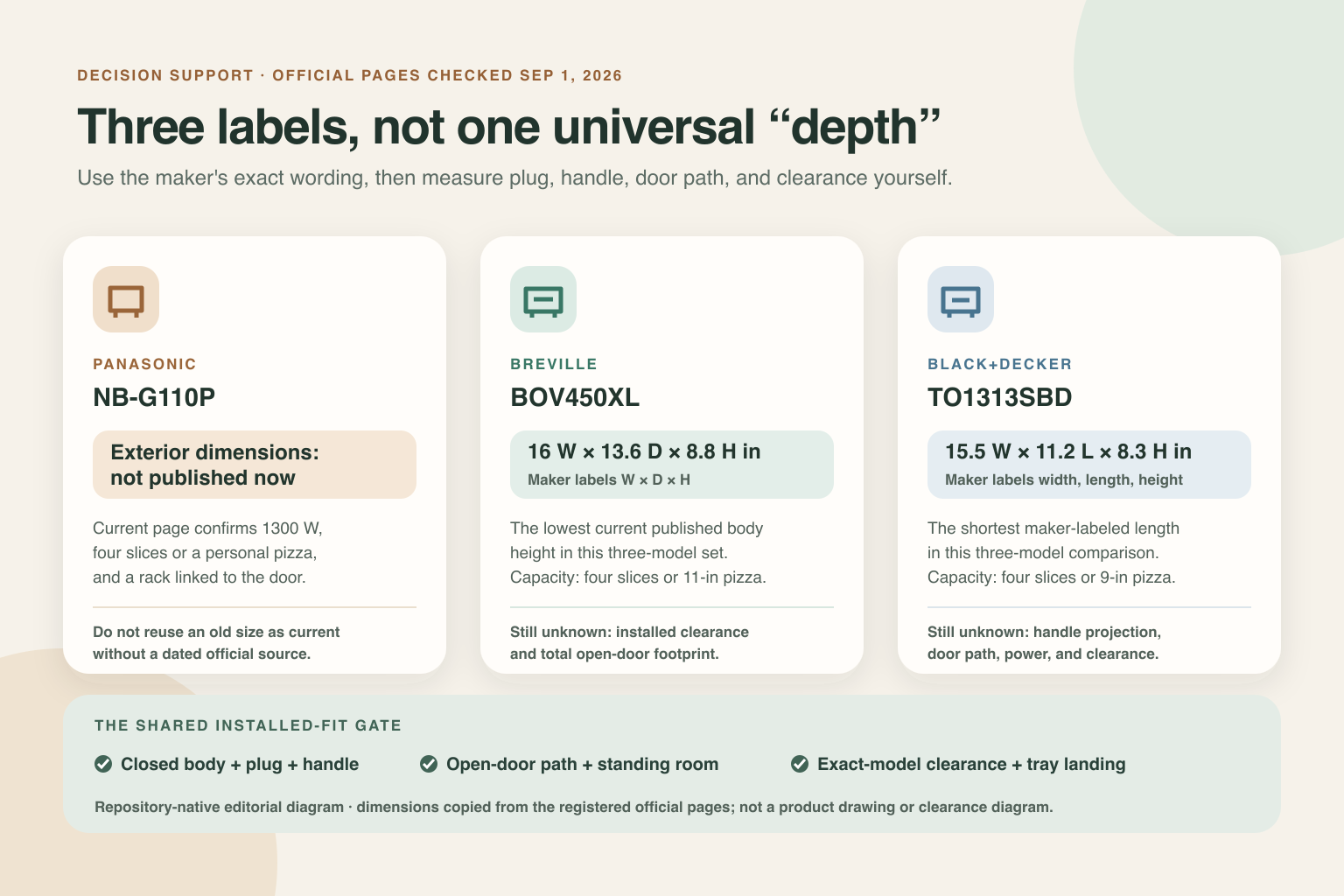
Build a paper template before opening a product link
Cut one sheet to the published closed footprint for the model you are considering and place it on the intended counter. For BLACK+DECKER, preserve the maker's wording: width, length, and height. For Breville, preserve width, depth, and height. Labels are not interchangeable evidence. If the manufacturer does not state which dimension runs front to back, confirm that orientation before using the template as a buying gate.
Add a second sheet or taped outline for the operating zone. Open the drawer below, stand where you would unload food, and leave the normal cutting board, dish rack, and coffee equipment in place. This is where a compact-looking oven often fails. The body can clear the wall while the open door blocks the only drawer, or the hot pan can require a landing spot that was already assigned to prep.
Panasonic needs a different template: an unresolved one. Mark the intended location, plug route, door path, and landing area, but leave the body dimensions blank until a current official document fills them. That blank is useful. It prevents an archived size from becoming false precision and makes the next action obvious: obtain exact-model documentation or remove the model from the shortlist.
- Write the source date on every paper template.
- Keep dimension labels exactly as the maker publishes them.
- Test adjacent drawers, cabinet doors, and the standing path.
- Leave the usual prep tools on the counter during the rehearsal.
- Stop when a body size, door path, or clearance remains unknown.
Where each model earns or loses the recommendation
Choose BLACK+DECKER when the counter's controlling constraint is the maker-labeled 11.2-inch length and the 15.5-inch width still leaves a separate landing surface. Its advantage ends at the closed number. If the handle or open door projects into the walkway, or if exact clearance cannot be verified, the right alternative is another location rather than pretending Breville or Panasonic automatically solves the same failure.
Choose Breville when the 8.8-inch closed height and 11-inch pizza capacity answer a real use case, and the larger 16-by-13.6-inch rectangle still fits with room to operate. Rule it out when depth is already the limiting dimension or when the oven would consume the only safe unloading patch. The lower body is a relevant comparison fact; it is not a substitute for overhead-clearance instructions.
Keep Panasonic conditional when the door-connected rack seems useful for access. The current page supports that mechanism and the 1300 W power claim, but not the exterior envelope this guide needs. Until those dimensions and clearances are current and model-specific, Panasonic cannot displace a fully measurable option on a tight counter. A retailer image, customer answer, or remembered specification is not enough to close that evidence gap.
What this refresh proves and when to check again
This comparison uses the exact three affiliate destinations supplied by Headquarters, while every product claim in the article comes from the registered manufacturer page for that model. It does not use changing commercial terms, retailer popularity signals, retailer dimensions, or invented hands-on experience. The editorial diagrams are original repository-native explanations; they are not scale drawings, product photographs, or manufacturer clearance diagrams.
Recheck this guide when any registered maker page changes, when a model is replaced, or before a later seasonal buying window. The immediate reader action is narrower: measure the real counter, draw the full operating zone, then open the exact product link only for a model that survives those checks. If none survives, keep the counter clear and postpone the purchase.
Real models to compare against the decision
These are reference models, not universal winners or a ranked list. Each exact listing is paired with source evidence; your use case and constraints still decide whether it belongs on the shortlist. Rule-out checks identify unresolved facts or incompatible conditions instead of inventing generic cons.
| Fit profile | Exact model | Capacity | Published closed size | Power |
|---|---|---|---|---|
| Evidence-incomplete body with door-linked rack access | Panasonic FlashXpress NB-G110P toaster oven | 4 slices or a personal pizza | unknown; current official product page does not publish exterior dimensions | 1300 W |
| Low closed body with the largest documented footprint | Breville Mini Smart Oven BOV450XL | 4 slices or an 11 in pizza | 16 in W x 13.6 in D x 8.8 in H | 1800 W |
| Shortest maker-labeled length with unresolved operating space | BLACK+DECKER TO1313SBD 4-slice toaster oven | 4 slices or a 9 in pizza | 15.5 in W x 11.2 in L x 8.3 in H | unknown on the registered official product page |
Closed-size figures do not include drawer, lid, cup, or hand movement. “Not published” is a verify-before-buying flag, not an estimate.
Best for: Keep it conditional when the door-connected rack matters more than a complete size record.
Panasonic FlashXpress NB-G110P toaster oven
Panasonic currently supports a door-connected rack, compact four-slice capacity, and 1300 W power, but not the exterior dimensions or exact clearances required to approve a shallow-counter fit.
Verified facts- The current official page identifies model NB-G110P and lists 1300 W power.
- The official page describes capacity for four slices or a personal pizza.
- The official page says the baking rack is connected to the oven door and moves toward the user as the door opens.
- The current registered page does not publish exterior dimensions.
- Closed width, depth, and height remain unknown in the current registered evidence.
- Handle projection, plug routing, open-door footprint, and model-specific clearance are not established.
- Without the exterior envelope, this model cannot receive a tight-counter recommendation.
Paid link — I may earn a commission from a qualifying purchase. No price or rating is stored here.
Best for: Choose it when low body height and 11-inch pizza capacity outweigh counter depth.
Breville Mini Smart Oven BOV450XL
Breville publishes a 16-by-13.6-by-8.8-inch closed body, 1800 W power, and 11-inch pizza capacity; choose it only when the larger footprint still leaves a safe operating and unloading zone.
Verified facts- The current official page lists 16 in W x 13.6 in D x 8.8 in H for model BOV450XL.
- The official page documents capacity for four slices or an 11 in pizza.
- The official page lists 1800 W power.
- The official page describes eight preset cooking functions.
- The published body is the widest and deepest in this three-model set.
- The current registered page does not establish the complete plug, handle, door, or unloading footprint.
- Model-specific placement clearance still has to be confirmed for the actual cabinet arrangement.
Paid link — I may earn a commission from a qualifying purchase. No price or rating is stored here.
Best for: Choose it when the maker-labeled 11.2-inch length is the first fit gate.
BLACK+DECKER TO1313SBD 4-slice toaster oven
BLACK+DECKER publishes a 15.5-by-11.2-by-8.3-inch closed body and 9-inch pizza capacity, but the short length does not resolve handle, door, plug, landing, or clearance needs.
Verified facts- The current official page lists 15.5 in W x 11.2 in L x 8.3 in H for model TO1313SBD.
- The official page documents capacity for four slices or a 9 in pizza.
- The official page describes a removable crumb tray.
- The maker uses the label length rather than depth for the 11.2 in figure.
- The published length is a closed-body fact, not a verified installed depth.
- Handle projection, open-door travel, plug routing, and model-specific clearance remain unknown.
- Its 15.5 in width can rule it out even when the front-to-back number fits.
Paid link — I may earn a commission from a qualifying purchase. No price or rating is stored here.
Before-you-buy checklist
- Measure the usable counter rectangle between fixed boundaries.
- Add plug and handle projection outside the closed-body outline.
- Trace the full door, rack, pan, and standing-room path.
- Reserve a separate heat-safe landing surface before purchase.
- Apply only exact-model rear, side, and overhead clearance.
- Keep maker dimension labels and source dates on the template.
- Delay the purchase when any required fit field remains unknown.
Sources and verification
Sources support the measurement method and examples above. Product-specific recommendations require a current manufacturer page or manual for that exact model.
- FlashXpress Toaster Oven NB-G110PPanasonic
- The Mini Smart Oven BOV450XLBreville
- 4-Slice Convection Oven TO1313SBDBLACK+DECKER
- Panasonic FlashXpress NB-G110P toaster ovenAmazon verified affiliate listing
- Breville Mini Smart Oven BOV450XLAmazon verified affiliate listing
- BLACK+DECKER TO1313SBD 4-slice toaster ovenAmazon verified affiliate listing