Choose the Cuisinart CPT-122 for a documented compact two-slot footprint, the BLACK+DECKER TR1278BD for extra-wide slots and simple controls, or the DASH DVTS501GY when its long clear-view chamber solves a specific bread problem. Measure the counter and loading path first.
- Evidence
- 6 cited sources
- Decision checks
- 8 before-buying checks
- Model set
- 3 exact models, not a ranking
- Testing basis
- Published-source review
The short answer: the counter measurement decides this comparison
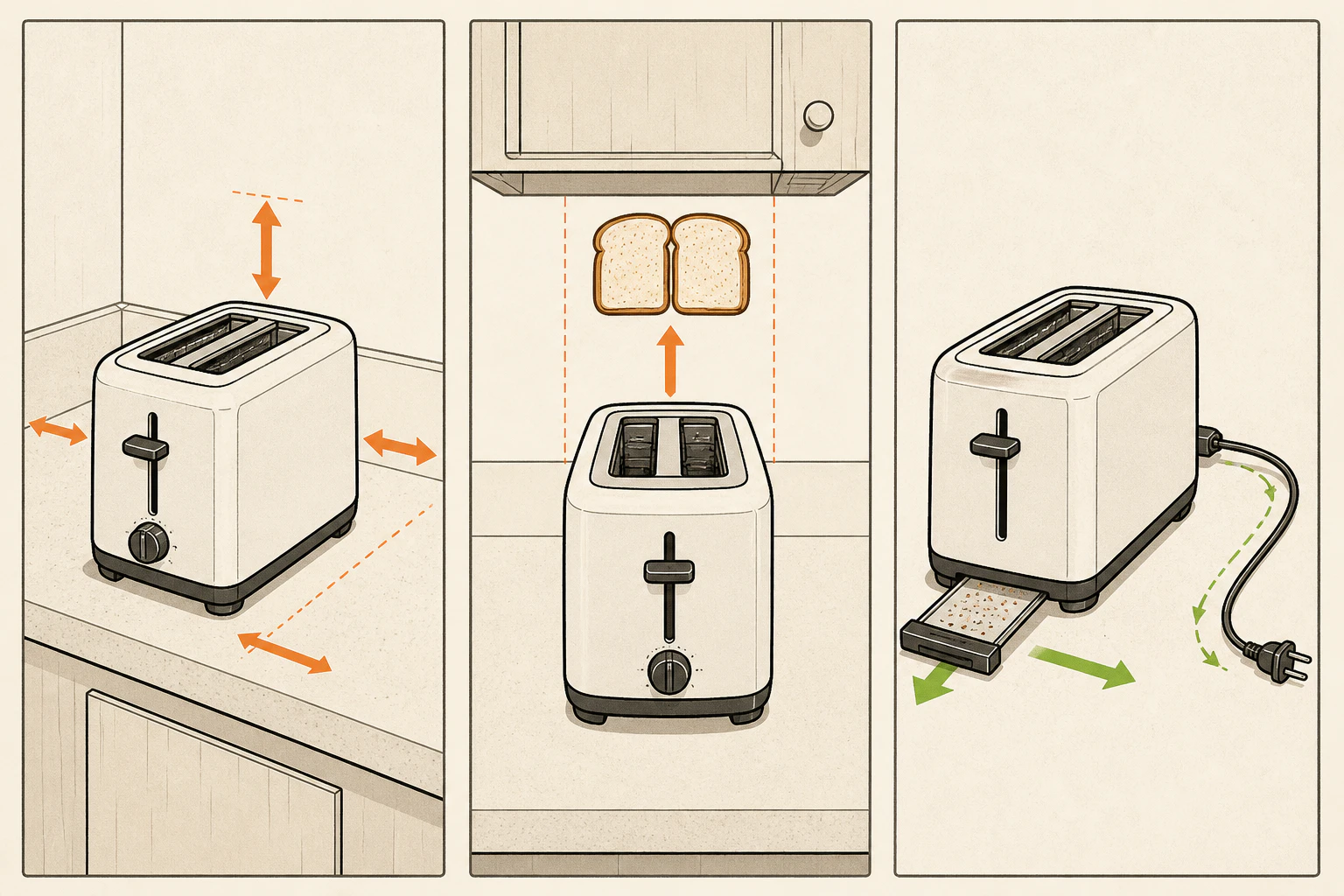
The expensive mistake with a small-counter toaster is measuring only the place where the appliance will sit. You also need to check the direction of the slots, the space above them for loading, the route to the outlet, and whether the crumb tray or other removable parts can be accessed without moving the toaster. The official BLACK+DECKER manual specifically says the top of the unit needs enough space for heat to flow without damaging cabinets or walls. That is a manufacturer-required operating condition, not a dimension you can safely estimate from a product photo.
For a conventional compact two-slot format, the Cuisinart CPT-122 is the clearest fit in this packet: its official page lists 6.5 inches long by 11 inches wide by 7.2 inches high, with 1.5-inch-wide slots, seven shade settings, reheat, defrost, bagel controls, and a slide-out crumb tray. If your bread is usually standard sliced bread and your counter is narrow, start there.
If thick or irregular bread is the recurring problem, the BLACK+DECKER TR1278BD has the more relevant documented layout: extra-wide slots with self-adjusting guides, a toast lever with extra lift, frozen and bagel buttons, and a crumb door underneath. Its manual does not provide a closed footprint in the supplied evidence, so it cannot be cleared for a particular counter by feature description alone.
The DASH DVTS501GY is the special-case choice. The supplied catalog identifies it as the Clear View Toaster, while the official DASH page lists a 7.8-inch by 15.7-inch by 6.6-inch product-family footprint, seven browning levels, an extra-wide chamber, a clear-view window, one-touch defrost, reheat, and bagel functions, plus a slide-out crumb tray and glass window. The official page displays SKU DVTS501RD, not DVTS501GY, so confirm the exact color/model identity before purchase. Its longer listed dimension makes it the least forgiving option when counter length is the hard limit.
- Primary fit rule: measure the available counter rectangle and the overhead loading path before comparing controls.
- Do not treat a listed closed dimension as the same thing as required operating clearance.
- If the DASH model identity or the BLACK+DECKER footprint cannot be verified for your space, the safer decision may be to postpone purchase.
A restrained buying step, after the first fit check
If the measured counter space and overhead path already fit your preferred layout, you can check the supplied Amazon listings for the exact ASINs. These are affiliate links, so Puni Guides may earn a commission if you buy through them; the links do not change the fit conclusions above. Verify the model identifier on the listing before ordering, especially for the DASH color/SKU mismatch.
Open only the model whose fit conditions above match your counter. The labeled retailer links below point to the exact Amazon ASINs; verify the model name before ordering.
Compare the physical burden, not just the feature list
The Cuisinart has the most usable footprint information for a small-counter decision. Its official 11-inch listed width and 7.2-inch height give you a starting box to mark on the counter. The page also says the toaster can be placed sideways or facing forward, but that does not remove the need to check the cord route and the loading direction in your own kitchen. A sideways orientation may change how much counter edge is occupied even if the closed appliance dimensions do not change.
The BLACK+DECKER evidence is stronger on access than on footprint. The lever provides extra lift if food does not clear the top, and the manual instructs you to open the crumb door underneath after the unit cools and is unplugged. That means the storage question is practical: if you plan to put the toaster away after use, the storage spot must allow you to retrieve it, orient it, and access the underside when removing crumbs. The manual also identifies a cord wrap under the unit, adding another reason to inspect the underside before choosing a shelf or tight cubby.
The DASH has the clearest documented cleaning access. Its official page says both the crumb tray and glass window slide out. That can matter when the toaster remains on the counter because cleaning does not depend only on shaking crumbs out of a fixed cavity. It can also add a handling step: the glass window is a removable component, so the storage location should protect it from being knocked or stacked against other items. The official page does not state a required rear, side, or overhead clearance number, so do not convert its dimensions into a complete installation plan.
None of these sources establishes browning evenness, speed, durability in your kitchen, or compatibility with every bread shape. The documented controls can explain what each model is designed to handle; they cannot prove the result will be uniform for your bread.
- Closed dimensions: Cuisinart provides 6.5 in L x 11 in W x 7.2 in H; DASH provides 7.8 in x 15.7 in x 6.6 in without labeling the axes on the page; the supplied BLACK+DECKER manual does not provide a closed footprint.
- Operating space: BLACK+DECKER explicitly requires enough top space for heat flow; the supplied Cuisinart and DASH pages do not state a numeric clearance requirement.
- Access: Cuisinart uses a slide-out crumb tray; BLACK+DECKER uses an underside crumb door; DASH lists a slide-out crumb tray and glass window.
- Storage burden: BLACK+DECKER underside access and DASH removable glass are specific handling considerations; no source supplies a storage-volume requirement.
Where the bread format changes the verdict
Choose the Cuisinart CPT-122 when you want the least complicated fit decision: a conventional two-slot body, a documented 1.5-inch slot width, seven shade settings, and dedicated reheat, defrost, and bagel controls. Its distinct advantage in this comparison is not a claim about better toast. It is that the official page gives you enough closed dimensions to draw a first counter template. Rule it out when your normal bread use depends on a long single chamber or when the available placement cannot accommodate its 11-inch listed width plus safe operating access. In that case, the DASH is the adjacent supplied alternative only if its larger listed footprint fits; otherwise, do not buy a toaster until the bread-format requirement is resolved.
Choose the BLACK+DECKER TR1278BD when extra-wide slots and basic specialty-bread controls are more important than visual access. The official manual names self-adjusting guides, a frozen button, a cancel button, a bagel button, seven shade positions, and an extra-lift lever. Its distinct advantage is straightforward control and retrieval support for thicker items. Rule it out when you cannot obtain the exact closed dimensions or when the underside crumb door would be inaccessible in your intended placement. If those conditions fail, the Cuisinart offers better documented footprint information, while the DASH offers more documented removable cleaning access.
Choose the DASH DVTS501GY when seeing the food through a clear-view window and using an extra-wide chamber are absolute requirements. Its distinct advantage is the combination of visual access and removable cleaning components. Rule it out when the 15.7-inch listed product-family dimension cannot fit on the counter, when you need a conventional two-slot layout, or when the exact DVTS501GY identity cannot be confirmed because the official page displays DVTS501RD. If clear viewing is not essential, the Cuisinart is the more defensible small-counter alternative because its compact dimensions are explicitly listed.
A no-purchase alternative is reasonable if your counter has no safe overhead loading path, no accessible outlet, or no place to remove crumbs without moving other appliances. A toaster that technically fits when cold can still be the wrong appliance for the working space.
The Puni Guides fit worksheet
Use this worksheet before opening a product page. It is deliberately more demanding than tracing the outside rectangle because the failure usually occurs during loading, cleaning, or storage.
1. Mark the usable counter rectangle. Record the maximum width, front-to-back depth, and available height. For the Cuisinart, compare your marks with the official 6.5-inch by 11-inch by 7.2-inch listing. For the DASH, record both possible orientations because the official page gives 7.8 inches by 15.7 inches by 6.6 inches without labeling the axes. For the BLACK+DECKER, leave the footprint as “not verified” until you obtain a model-specific dimension from an allowed source.
2. Draw the loading path. Can you insert bread from above without striking a cabinet, shelf, or microwave? The BLACK+DECKER manual requires top space for heat flow. The Cuisinart and DASH packet does not provide a numeric overhead clearance, so mark that item as “manufacturer value unavailable,” not as zero.
3. Test access with a paper stand-in. Leave room for the Cuisinart crumb tray to slide out, the BLACK+DECKER underside crumb door to open, or the DASH crumb tray and glass window to slide out. This is an access check, not an inferred clearance measurement; the sources document the removable feature but do not specify how much surrounding room your kitchen needs.
- Counter: measure width, depth, and height; include the outlet and cord route.
- Loading: check the overhead path and the direction in which bread enters the toaster.
- Bread: identify whether standard slices, bagels, frozen items, thick slices, or long specialty bread drive the decision.
- Cleaning: confirm access to the documented crumb tray, crumb door, or removable glass.
- Storage: decide whether the unit stays out and whether removable parts need protected storage.
- Identity: match the exact ASIN and model; treat the DASH DVTS501GY/DVTS501RD discrepancy as a verification stop.
Evidence limits that should change your decision
The Cuisinart official page supports its model identity, dimensions, slot width, controls, shade settings, crumb tray, and limited warranty. It does not provide a numeric operating-clearance diagram in the supplied source. The BLACK+DECKER manual supports the TR1278BD model family, controls, extra-wide self-adjusting slots, extra-lift lever, underside crumb door, cleaning instructions, and the top-space safety instruction. It does not provide a closed footprint in the supplied packet. The DASH official page supports the Clear View Toaster features, dimensions, weight, removable cleaning parts, and the displayed SKU DVTS501RD; it does not prove that every color variant has identical dimensions or establish numeric clearance requirements.
The comparison therefore answers a narrower question than “which toaster is best?” It identifies which documented fit condition is most likely to decide whether each supplied model belongs on your counter. Browning quality, toast speed, long-term durability, and real-world fit in your particular cabinet layout remain unverified here. If your decision depends on one of those unknowns, the correct next action is to locate an exact allowed manual or manufacturer specification before purchasing.
Real models to compare against the decision
These are reference models, not universal winners or a ranked list. Each exact listing is paired with source evidence; your use case and constraints still decide whether it belongs on the shortlist. Rule-out checks identify unresolved facts or incompatible conditions instead of inventing generic cons.
| Fit profile | Exact model | Capacity | Published closed size | Power |
|---|---|---|---|---|
| Documented compact conventional two-slot fit | Cuisinart CPT-122 2-Slice Compact Plastic Toaster, Slots for Bagels & Bread, 7 Shade Settings, Cancel/Defrost/Reheat Functions, Removable Crumb Tray, Small Kitchen Appliance for Home & Office, White | Not provided in current catalog | 6.5 in L x 11 in W x 7.2 in H | Not provided in current catalog |
| Extra-wide-slot control and access fit | BLACK+DECKER 2-Slice Toaster with Extra-Wide Slots | Not provided in current catalog | Not provided in current catalog | 850 W |
| Clear-view specialty-bread fit with the largest listed counter dimension | DASH Clear View Toaster: Extra Wide Slot Toaster with See Through Window - Defrost, Reheat + Auto Shut Off Feature for Bagels, Specialty Breads & other Baked Goods - Grey | Not provided in current catalog | 7.8 in x 15.7 in x 6.6 in | Not provided in current catalog |
Closed-size figures do not include drawer, lid, cup, or hand movement. “Not published” is a verify-before-buying flag, not an estimate.
Best for: Small counters that need a conventional two-slot toaster with documented dimensions and 1.5-inch-wide slots.
Cuisinart CPT-122 2-Slice Compact Plastic Toaster, Slots for Bagels & Bread, 7 Shade Settings, Cancel/Defrost/Reheat Functions, Removable Crumb Tray, Small Kitchen Appliance for Home & Office, White
Choose the Cuisinart CPT-122 when its listed 6.5 in L x 11 in W x 7.2 in H body fits and conventional two-slot use is the priority. Its advantage is the strongest documented footprint in this set. Rule it out when long specialty bread is non-negotiable or the loading path fails; compare the DASH only if its longer body fits.
Verified facts- The official Cuisinart page identifies the model as CPT-122.
- The official page lists dimensions of 6.5 in L x 11 in W x 7.2 in H.
- The official page lists 1.5-inch-wide toasting slots.
- The official page lists a seven-setting shade dial, reheat, defrost, and bagel controls.
- The official page lists a slide-out crumb tray and a limited three-year warranty.
- The supplied official page does not state a numeric operating-clearance requirement.
- The source does not establish browning evenness, toast speed, durability in use, or compatibility with every bread shape.
- The closed dimensions do not by themselves determine the required space for loading, cord routing, or crumb-tray access.
Paid link — I may earn a commission from a qualifying purchase. No price or rating is stored here.
Best for: Readers who regularly use thicker or specialty bread and can verify the toaster’s footprint before placement.
BLACK+DECKER 2-Slice Toaster with Extra-Wide Slots
Choose the BLACK+DECKER TR1278BD when extra-wide self-adjusting slots, bagel and frozen controls, and extra lift match your bread routine. Its advantage is straightforward specialty-bread handling. Rule it out when the underside crumb door is inaccessible or the unlisted footprint cannot be verified; compare the Cuisinart for clearer dimensions.
Verified facts- The supplied manual lists TR1278BD among the covered models.
- The manual identifies extra-wide slots with self-adjusting guides.
- The manual identifies a toast control lever with extra lift, frozen button, cancel button, toast shade selector, bagel button, cord wrap under the unit, and crumb door under the unit.
- The manual instructs users to provide enough top space for heat to flow without damaging cabinets or walls.
- The manual lists an 850 W rating and 120 V 60 Hz supply in the supplied catalog packet.
- The supplied manual does not provide a closed width, depth, or height for the exact model.
- The manual documents the need for top space but does not provide a numeric clearance value.
- The source does not establish browning evenness, toast speed, durability in use, or a particular counter fit without measurement.
- The manual’s cleaning instructions require the unit to cool and be unplugged before crumb removal or cleaning.
Paid link — I may earn a commission from a qualifying purchase. No price or rating is stored here.
Best for: Readers who need a clear-view extra-wide chamber and can verify both the exact gray model and available space.
DASH Clear View Toaster: Extra Wide Slot Toaster with See Through Window - Defrost, Reheat + Auto Shut Off Feature for Bagels, Specialty Breads & other Baked Goods - Grey
Choose the DASH DVTS501GY when its clear-view window and extra-wide chamber solve a real bread-use problem. Its advantage is visible progress plus removable cleaning parts. Rule it out when the 15.7-inch product-family dimension does not fit, conventional two-slot use is enough, or the exact gray model cannot be confirmed.
Verified facts- The supplied catalog identifies the model as DVTS501GY and the official page identifies the product family as Clear View Toaster.
- The official page lists seven browning levels, a clear-view window, an extra-wide chamber, one-touch defrost, reheat, and bagel functions.
- The official page states that the crumb tray and glass window slide out for cleaning.
- The official page lists dimensions of 7.8 in x 15.7 in x 6.6 in and weight of 4.5 lb.
- The official page lists SKU DVTS501RD.
- The official page displays SKU DVTS501RD, while the supplied ASIN packet identifies DVTS501GY; exact color/model identity requires confirmation.
- The page does not label which listed dimension corresponds to width, depth, or height.
- The listed dimensions are presented as product-family dimensions in the supplied packet; identical dimensions across color variants are not independently established.
- The source does not establish browning evenness, toast speed, durability in use, or numeric operating clearances.
Paid link — I may earn a commission from a qualifying purchase. No price or rating is stored here.
Before-you-buy checklist
- Measure the counter width, depth, and height where the toaster will operate.
- Check the overhead loading path and the outlet/cord route.
- Compare the Cuisinart template with 6.5 in L x 11 in W x 7.2 in H.
- Do not approve the BLACK+DECKER for a tight location without a verified closed footprint.
- Treat the DASH 7.8 in x 15.7 in x 6.6 in dimensions as product-family dimensions and verify the exact DVTS501GY identity.
- Leave access for the crumb tray, underside crumb door, or removable glass window.
- Do not infer browning evenness, performance, or unstated clearance from these sources.
- If no model fits the safe operating path, choose no purchase or reassess the appliance category.
Sources and verification
Sources support the measurement method and examples above. Product-specific recommendations require a current manufacturer page or manual for that exact model.
- Cuisinart CPT-122 2-Slice Compact Toaster specificationsCuisinart
- BLACK+DECKER TR1278 Series Use and Care ManualSpectrum Brands / BLACK+DECKER
- DASH Clear View Toaster specificationsDASH
- Cuisinart CPT-122 2-Slice Compact Plastic Toaster, Slots for Bagels & Bread, 7 Shade Settings, Cancel/Defrost/Reheat Functions, Removable Crumb Tray, Small Kitchen Appliance for Home & Office, WhiteAmazon verified affiliate listing
- BLACK+DECKER 2-Slice Toaster with Extra-Wide SlotsAmazon verified affiliate listing
- DASH Clear View Toaster: Extra Wide Slot Toaster with See Through Window - Defrost, Reheat + Auto Shut Off Feature for Bagels, Specialty Breads & other Baked Goods - GreyAmazon verified affiliate listing