Choose the COSORI Premium Mini when repeat batches justify a dedicated dehydrator and you can manage its opening path and loose accessories. Skip it when use is occasional or the working surface cannot support the routine. This guide decides fit; it does not report a tested result.
- Evidence
- 4 cited sources
- Decision checks
- 6 before-buying checks
- Model set
- 1 exact model
- Testing basis
- Published-source review
Start with the batch you will actually repeat
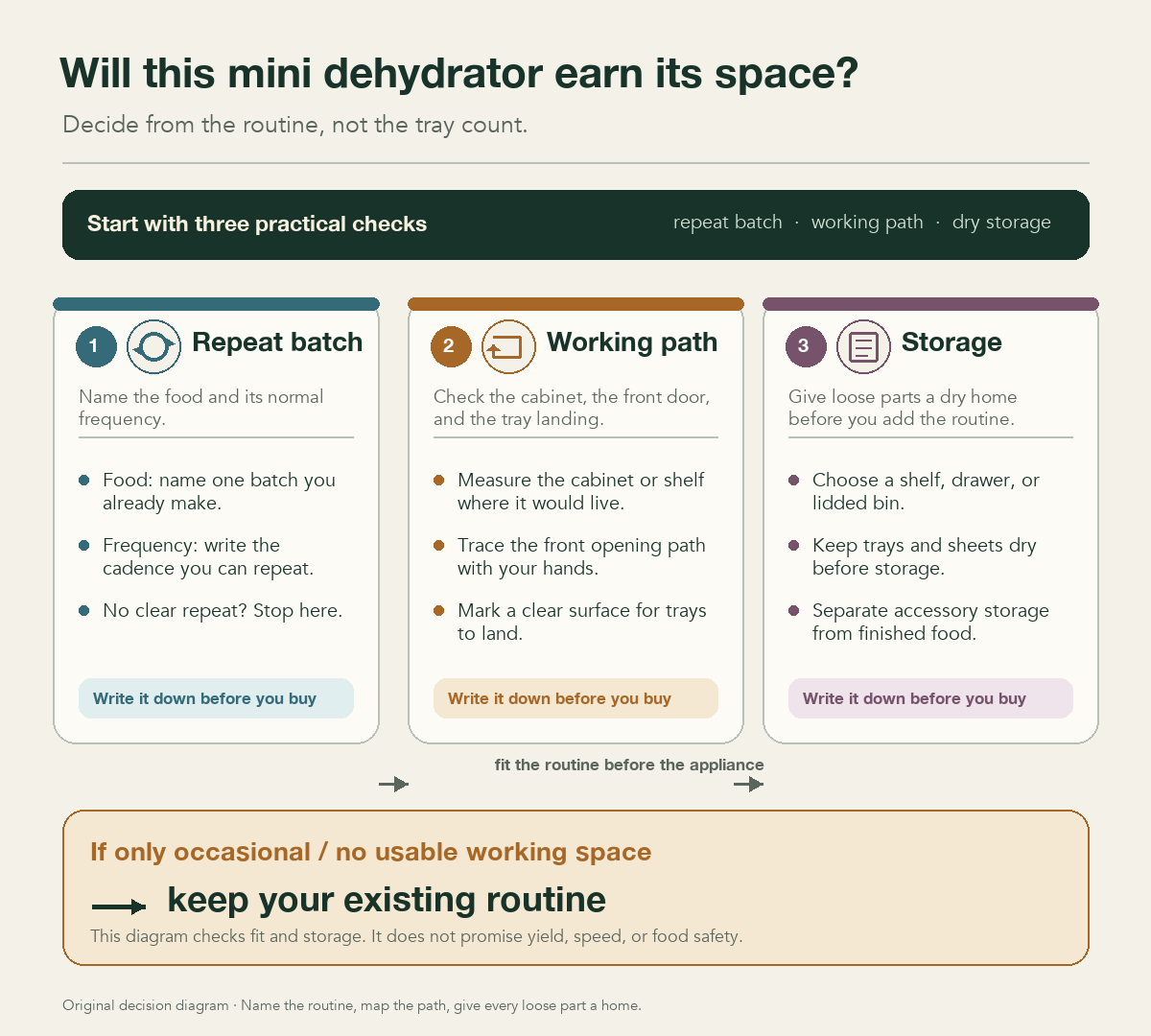
A mini food dehydrator earns space when it solves a routine you expect to repeat, not when its tray count sounds impressive. Start with food you already plan to prepare, such as a weekend fruit batch, herbs you use through the week, or vegetables you regularly buy. If you cannot name a repeatable use, the appliance may add storage and cleanup work instead of removing one.
Write down a normal month rather than an ideal month. Separate a routine from a one-time experiment, then note where the prepared food would cool and live. Include the container that would hold it after the batch. The decision is about the full path, not the label mini.
Measure the body and the working path
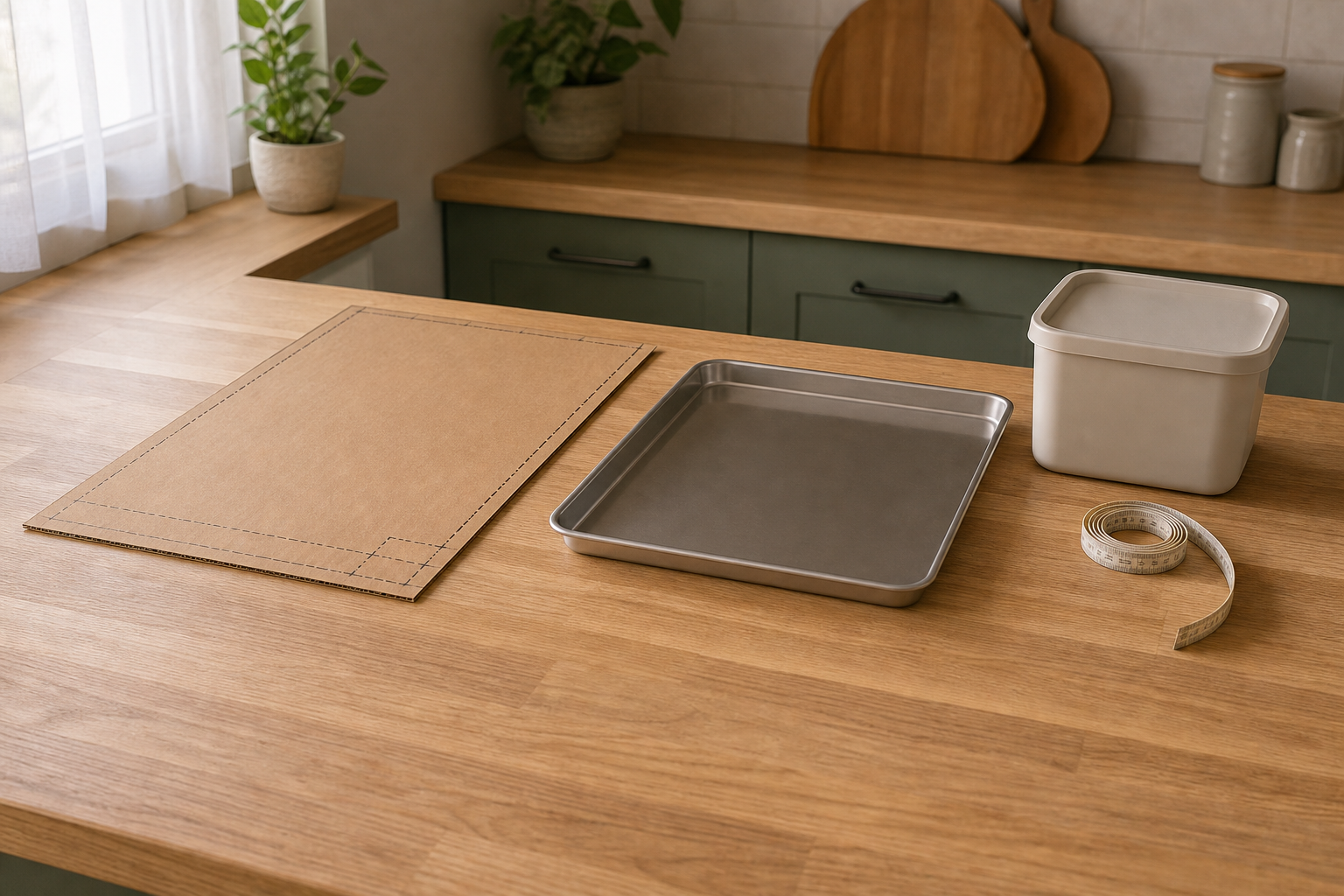
Measure the place where the unit would sit or be stored, then measure the route needed to open it and move food to a landing surface. Leave room for your hands, the door, and a container. A body that fits a shelf can still fail if the opening path crosses a sink, another appliance, or a crowded edge.
Draw the closed footprint and open path separately. Mark the narrowest width, usable depth, and a surface for loose pieces to cool or dry. If storage and operation happen in different places, test both before calling the purchase space-saving.
Use the model-specific operating boundaries
The CFD-P501-SUS manual lists AC 120 V/60 Hz, 480 W, a 95–176 °F control range, and a 30-minute–48-hour timer. It identifies five stainless trays, a mesh screen, and a fruit roll sheet. The trays are dishwasher safe; the mesh screen and fruit roll sheet are not. The manual directs the owner to unplug and cool the unit, wipe the housing with a damp cloth, dry parts before storage, and keep the cord, plug, and housing out of water. It lists a 13.9 × 11.3 × 8.9-inch closed body and gives a tray-load instruction; neither establishes finished yield. It calls for a solid, level, heat-resistant surface; when the timer ends, heating stops and the fan cools briefly.
The current product-page summary shows 95–165 °F, so the page and manual remain an unresolved specification difference. Treat both as control descriptions, not proof of drying speed, evenness, preservation safety, or a food-specific setting. The maker materials publish no numeric front-clearance figure, so measure that path yourself.
Plan one repeatable batch and its storage
Turn the routine into a worksheet: name the food, how often you will prepare it, where ingredients are staged, where the finished food cools, and which container will hold it. Ask what happens on a busy week. If the answer requires clearing another appliance or leaving pieces on the counter, the routine may be too fragile.
Use a hypothetical weekend batch to walk through prep, loading, unloading, cooling, and storage. Do not assume a time, yield, or texture result. The exercise exposes missing surfaces and repeated handling before you spend money.
Give every loose piece a home
Accessory storage deserves its own decision. Pick a dry shelf, drawer, or lidded bin before purchase, and decide whether the pieces are reachable without moving other tools. Keep the drying place separate from finished-food storage.
Also decide how you will label and rotate food after each batch. A container, date note, and consistent shelf make the routine easier to judge; they do not prove freshness, shelf life, or safety. If there is no clear landing area, the appliance may add friction.
Keep the no-buy branch visible
The COSORI Premium Mini fits this reader when the routine is specific, the operating path works, and loose pieces have a stable home. It loses its case when use would be occasional, the location is only technically large enough, or the kitchen cannot support transfer and storage. Those are practical reasons to keep an existing method.
Repeat the worksheet on an ordinary week and an inconvenient week. If both versions work, the model has a plausible place. If either depends on a guessed result or an unplanned storage pile, pause. A no-buy answer is useful when the appliance does not solve the routine.
The exact model and its limits
Use the verified facts and limits below to decide whether this model fits your routine.
Best for: Choose it when repeat small batches justify a dedicated dehydrator.
COSORI Premium Mini 5-Tray Food Dehydrator
This single-model guide suits a reader who can name repeat batches, measure the storage and opening path, and give loose accessories a dry home. It is a source-bounded fit recommendation; it does not establish drying speed, evenness, finished yield, preservation safety, or hands-on performance.
Verified facts- COSORI identifies the selected item as the Premium Mini model CFD-P501-SUS.
- The recorded retail identity for this assessment is ASIN B0CHRWLM5Z.
- This guide does not establish drying speed, evenness, finished yield, preservation safety, or hands-on performance.
- Storage fit depends on the reader’s measured opening and landing path.
- Accessory storage and the repeat-batch routine still need a practical place.
Paid link — I may earn a commission from a qualifying purchase. No price or rating is stored here.
Before-you-buy checklist
- Name one repeat batch.
- Measure storage and the opening path.
- Choose prep and cooling surfaces.
- Assign a dry home for accessories.
- Check the outlet and operating location.
- Skip it if use stays occasional.
Sources and verification
Sources support the measurement method and examples above. Product-specific recommendations require a current manufacturer page or manual for that exact model.
- Primary: COSORI Premium Mini exact productCOSORI
- Primary: CFD-P501-SUS US manualCOSORI
- Recorded retail identity: COSORI Premium Mini five-tray modelAmazon
- COSORI Premium Mini 5-Tray Food DehydratorAmazon verified affiliate listing