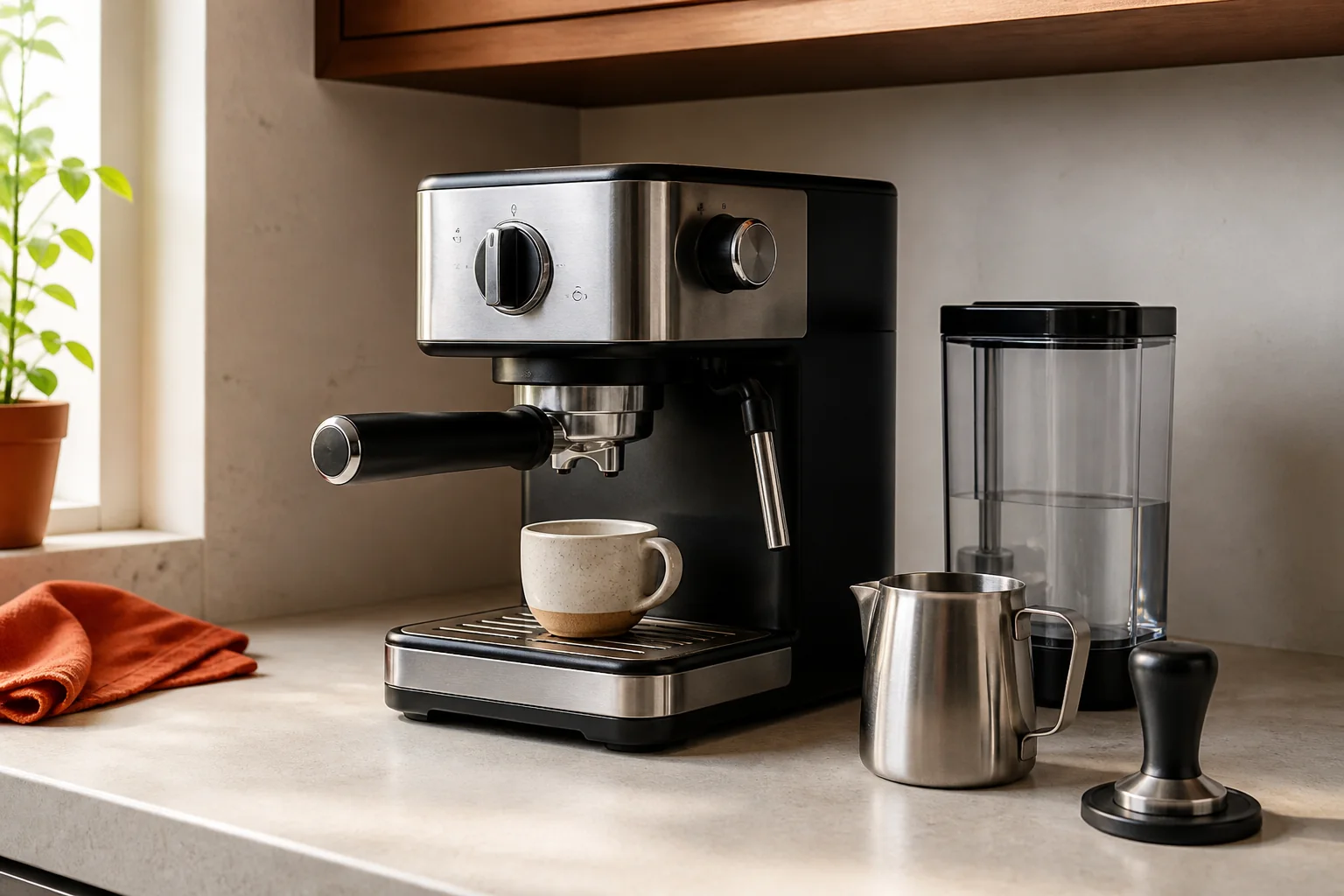
A narrow espresso machine can still need a wide working zone for the portafilter, steam wand, milk pitcher, tamping, and cleanup.
- Evidence
- 5 cited sources
- Decision checks
- 6 before-buying checks
- Model set
- 3 exact models, not a ranking
- Testing basis
- Published-source review
Turn the footprint into a working rectangle
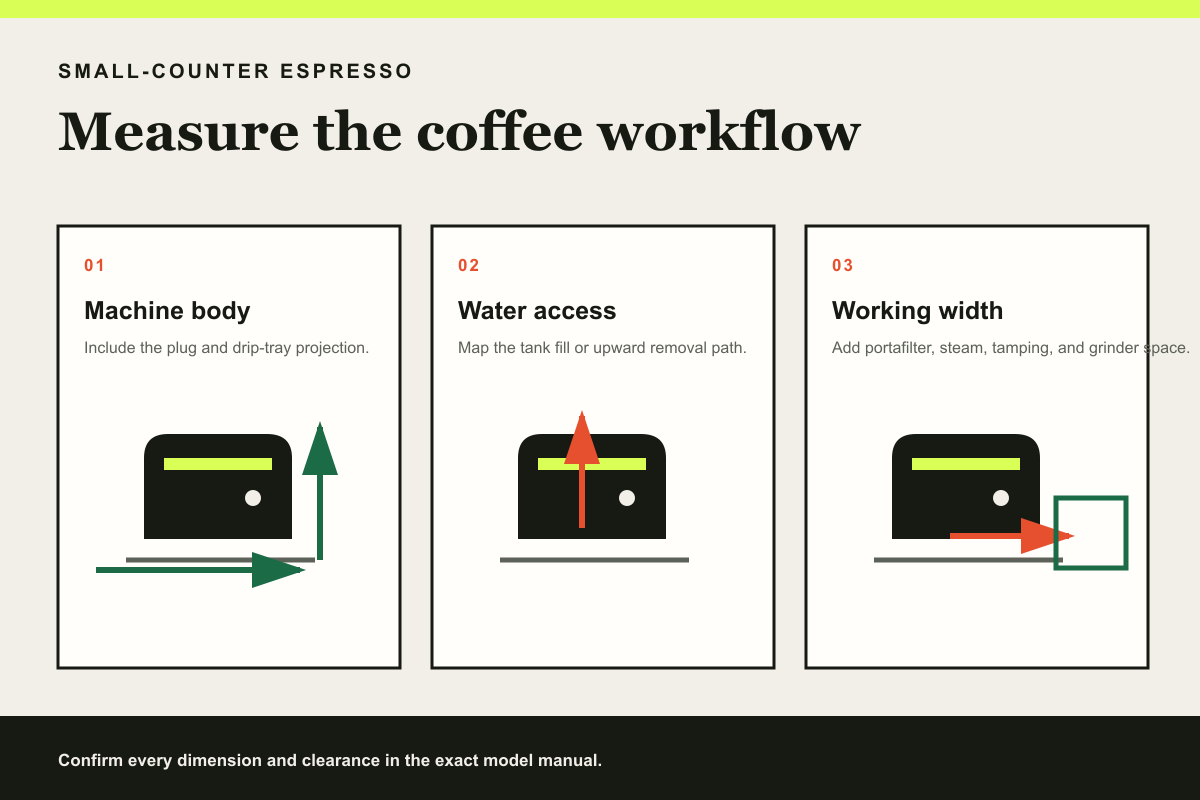
Start with the manufacturer's width, depth, and height, including the drip tray and rear projection. Then add the side-to-side motion of inserting and locking the portafilter. Its handle can sweep across space that the machine's narrow body never occupies.
Map the user's standing position and the place where the portafilter rests before and after brewing. A wall, refrigerator panel, or adjacent appliance can block the locking motion even when the base fits between them.
- Closed body dimensions and plug projection.
- Portafilter insertion and handle-swing area.
- Steam-wand movement and milk-pitcher space.
- A stable tamping and accessory zone.
Find the water before choosing the cabinet position
Check where the water tank sits, how it is filled, and whether it lifts upward or slides out. A rear tank may require pulling the machine forward, while a top-fill opening may conflict with an upper cabinet. Measure the actual refill path, not just tank capacity.
If daily movement is required, include the machine's weight, cord slack, and the water tank's spill route. A smaller reservoir can reduce body size but increase refill frequency, so compare capacity with the number of drinks you make in one session.
Reserve room for milk and preparation
Milk drinks expand the station beyond the machine. The steam wand needs room to pivot, the pitcher needs a safe angle beneath it, and the counter needs a place for the hot pitcher afterward. Confirm the wand movement in the exact instruction manual.
Ground coffee also needs a path: dosing, distribution, tamping, locking, knocking out the puck, and wiping the basket. A grinder may require more space than the espresso machine, so measure the complete station if it will remain on the counter.
Count maintenance as normal use
The drip tray, portafilter, baskets, water tank, milk pitcher, and cleaning tools all need washing or storage. Check how the drip tray exits and whether it can clear a nearby cabinet pull or sink lip without tilting.
Use the manufacturer manual for cleaning and descaling steps and note the supplies that must be stored. A compact machine is practical when its maintenance pieces have assigned places and the counter can stay usable during the routine.
Real models to compare against the decision
These are reference models, not universal winners or a ranked list. Each exact listing is paired with source evidence; your use case and constraints still decide whether it belongs on the shortlist. Rule-out checks identify unresolved facts or incompatible conditions instead of inventing generic cons.
| Fit profile | Exact model | Capacity | Published closed size | Power |
|---|---|---|---|---|
| Six-inch narrow-body espresso station | De'Longhi Dedica DeLuxe EC685M | 1- or 2-cup filter holder / E.S.E. pod | W 6 in; other dimensions not on cited maker page | Not provided on cited maker page |
| Fifty-four-millimeter fast-heat workflow | Breville Bambino BES450BSS | 47 fl oz / 1.4 L water tank | 11.9 × 6.1 × 13.5 in (maker labels W×D×H) | 1560 W |
| Simple manual-boiler espresso workflow | De'Longhi Stilosa EC260BK | Not provided on cited maker page | Not provided on cited maker page | Not provided on cited maker page |
Closed-size figures do not include drawer, lid, cup, or hand movement. “Not published” is a verify-before-buying flag, not an estimate.
Best for: A narrow counter bay that can still support the portafilter, steam wand, grinder, and rear-tank workflow
De'Longhi Dedica DeLuxe EC685M
The official six-inch body width makes this the narrow-front candidate, but espresso preparation immediately expands beyond that rectangle. Add portafilter swing, milk pitcher, grinder, tamping, and the removable water-tank path before calling it a six-inch station.
Verified facts- De'Longhi identifies the exact EC685M as the Dedica DeLuxe and publishes a six-inch body width.
- The maker documents a one- or two-cup filter holder that also accepts E.S.E. pods, a 15-bar pump, and a manual adjustable frother.
- The product page lists a removable water tank, two-level drip tray, automatic standby, and cup clearance up to 12 centimeters with the tray configuration shown.
- The cited US maker page does not publish complete width-depth-height dimensions, water capacity, wattage, or portafilter swing.
- We have not hands-on tested this unit; measure the exact listing, rear refill path, steam-wand reach, and accessory station before ordering.
Paid link — I may earn a commission from a qualifying purchase. No price or rating is stored here.
Best for: A compact manual-milk station where a 54-millimeter portafilter and 47-ounce rear tank fit the routine
Breville Bambino BES450BSS
The Bambino's appeal is its 54-millimeter espresso workflow and fast heating, not just a compact label. Breville's current page publishes an unusually ordered dimension set, so confirm the physical orientation against the exact Amazon model before fitting it between fixed objects.
Verified facts- Breville identifies the exact BES450 as the Bambino and documents a 54-millimeter portafilter with an 18-gram dose workflow.
- The current product page labels dimensions as 11.9 × 6.1 × 13.5 inches W×D×H; the exact manual lists a 47-fluid-ounce removable tank.
- The manufacturer manual lists 120 V, 60 Hz, and 1560 W and documents manual milk texturing plus one- and two-cup volumetric controls.
- The maker's dimension order is unusual for the visible product form; verify orientation and the exact listing rather than rotating the numbers by assumption.
- The rear water tank, 54-millimeter portafilter, steam wand, milk jug, and 1560-watt load all extend the fit check beyond the closed body.
Paid link — I may earn a commission from a qualifying purchase. No price or rating is stored here.
Best for: A traditional manual espresso routine when every missing fit measurement can be confirmed before purchase
De'Longhi Stilosa EC260BK
Stilosa is included as the simpler manual-boiler workflow, not as a declared space winner. The official regional page confirms the exact model and core functions but omits the fit numbers needed for this guide, so it remains a verify-before-buying candidate.
Verified facts- De'Longhi identifies the exact EC260BK as the black Stilosa manual espresso machine.
- The maker documents a 15-bar pump, stainless-steel boiler, two-level cup holder, and manual milk frother.
- The product page describes the body as compact and the maintenance routine as easy to clean, without publishing numerical dimensions on the cited page.
- The cited official page does not publish numerical dimensions, water capacity, wattage, portafilter swing, or tank-removal clearance.
- Do not treat the compact label as proof of fit; verify the exact US listing and manual for every missing measurement before ordering.
Paid link — I may earn a commission from a qualifying purchase. No price or rating is stored here.
Before-you-buy checklist
- Add portafilter handle swing to the closed machine dimensions.
- Measure the exact path used to fill or remove the water tank.
- Reserve room for steam-wand movement and a milk pitcher.
- Include grinder, tamper, dosing, and puck-disposal space.
- Check cup clearance for the cups you actually use.
- Plan storage and cleaning for trays, baskets, tools, and descaling supplies.
Sources and verification
Sources support the measurement method and examples above. Product-specific recommendations require a current manufacturer page or manual for that exact model.
- Dedica DeLuxe EC685MDe'Longhi
- The Bambino Compact Espresso MachineBreville
- The Bambino Instruction ManualBreville
- Stilosa EC260BKDe'Longhi
- How to measure countertop space before buying an appliancePuni Guides