A small kettle needs a clear fill path, a safe steam path, and enough room to lift and pour without striking the cabinet.
- Evidence
- 4 cited sources
- Decision checks
- 6 before-buying checks
- Model set
- 3 exact models, not a ranking
- Testing basis
- Published-source review
Measure the full fill-and-pour motion
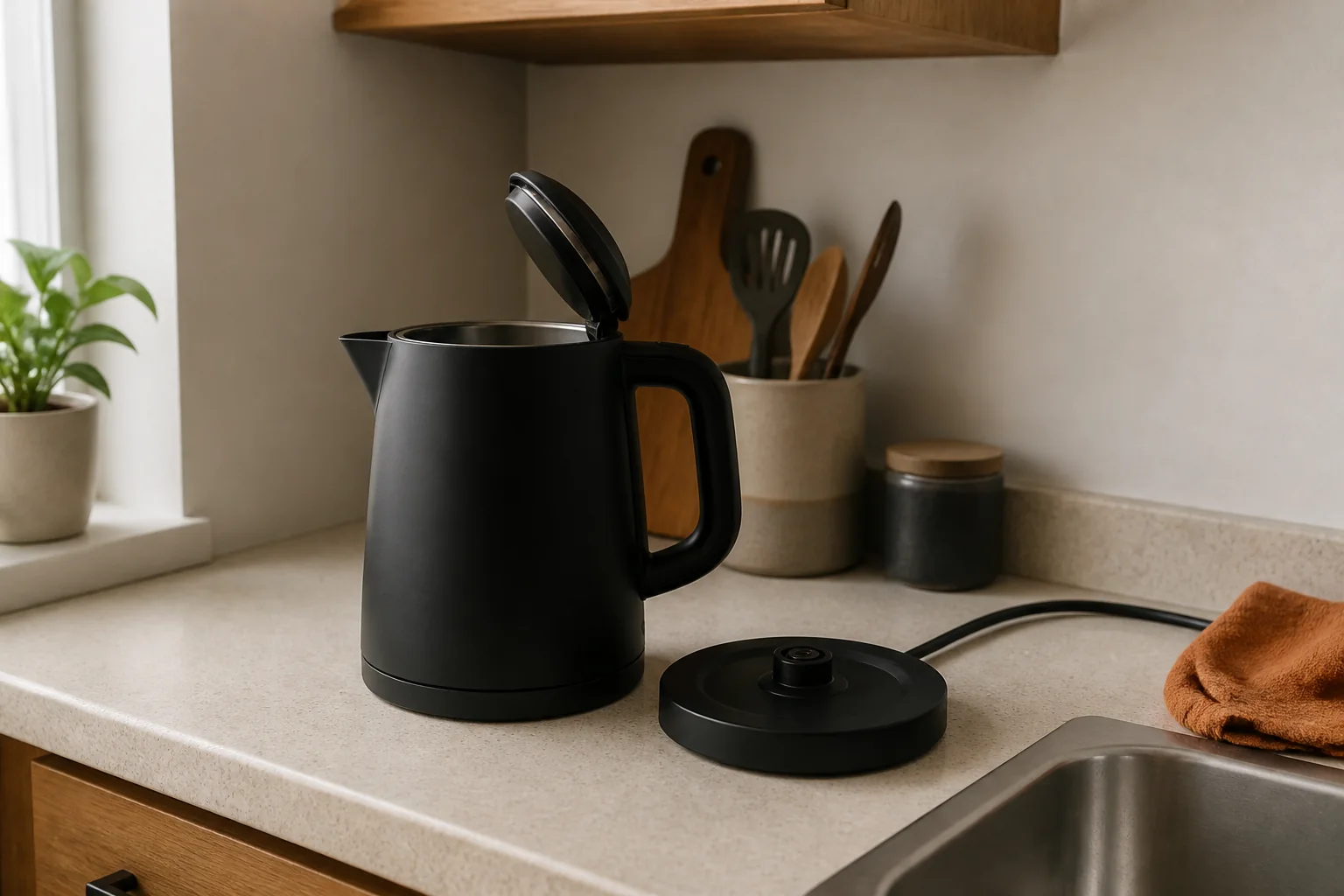
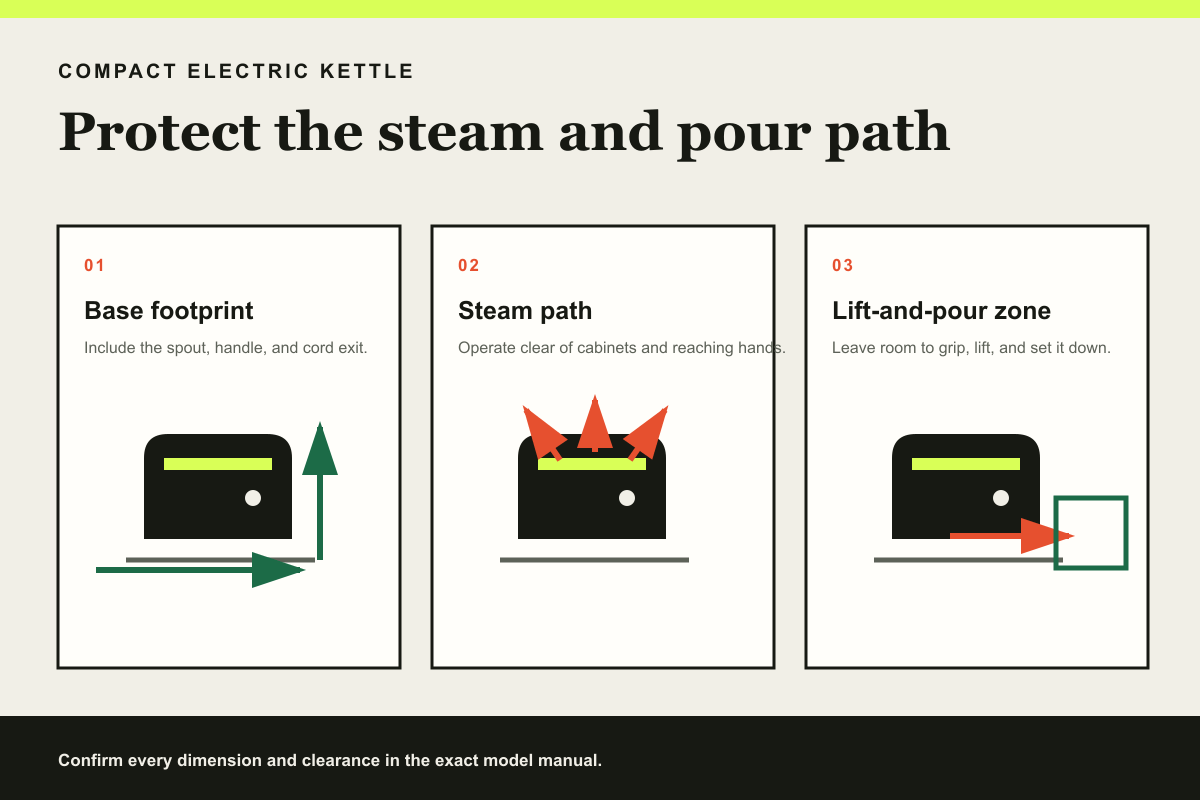
Begin with the kettle on its power base. Record closed height, handle width, spout projection, and the cord's exit direction. Then trace how the lid opens and how the kettle lifts from the base. A low body may still need several inches above it for a hinged lid or your hand.
Decide whether you fill at the sink, with a pitcher, or through the spout. Each method needs a different path. If the kettle must move for every refill, include a dry parking place for the base and a route that does not pull the cord across the sink.
- Closed footprint on the power base.
- Lid-open height and hand clearance.
- Handle clearance during lifting and pouring.
- Cord exit, outlet position, and excess-cord storage.
Give steam a deliberate route
Steam leaves through the spout or lid area and can reach the underside of an upper cabinet. Use the exact use-and-care guide for placement and operating cautions. Do not infer a safe overhead distance from another brand or from a styled kitchen photo.
Choose an operating position where steam does not hit a cabinet face, shelf contents, wall finish, or your hand as you reach for the handle. If the kettle is stored under a cabinet but operated farther forward, mark both positions and confirm the base remains stable.
Match capacity to the cups you actually make
Convert the stated capacity into your usual mug or teapot volume. Also check the model's minimum fill mark. A large maximum capacity is not useful if the kettle's minimum batch wastes water for a single cup.
Capacity affects weight as well as speed and footprint. Imagine lifting the kettle at your normal fill level, not empty. Handle shape and balance matter more in daily use than a small difference in the base diameter.
Include drying and descaling space
A kettle needs room to empty, cool, wipe, and occasionally descale according to its manual. Check whether the lid opening is wide enough for the cleaning method you can perform and whether the filter is removable.
Keep the power base and electrical connections out of the sink. A compact kettle is a good fit when the wet parts have a clear cleanup routine and the base can stay dry without occupying a second unplanned patch of counter.
Real models to compare against the decision
These are reference models, not universal winners or a ranked list. Each exact listing is paired with source evidence; your use case and constraints still decide whether it belongs on the shortlist. Rule-out checks identify unresolved facts or incompatible conditions instead of inventing generic cons.
| Fit profile | Exact model | Capacity | Published closed size | Power |
|---|---|---|---|---|
| Simple one-liter boil-only | Proctor Silex K2070PS 1-liter electric kettle | 1.0 L | Not published in cited guide | 1000 W |
| Preset temperatures and controlled pour | COSORI CO108-NK 0.8-liter gooseneck kettle | 0.8 L | Not published on cited maker page | 1200 W |
| Low-profile precision control | Fellow Corvo EKG Pro 0.9-liter electric kettle | 0.9 L | L 8.66 × W 6.69 × H 7.72 in | 1000–1200 W |
Closed-size figures do not include drawer, lid, cup, or hand movement. “Not published” is a verify-before-buying flag, not an estimate.
Best for: A simple one-liter kettle when steam and lid clearance are measurable
Proctor Silex K2070PS 1-liter electric kettle
The one-liter body is only the starting point. Confirm the lid-open hand path, a steam-safe operating position, and a dry route between the sink and power cord.
Verified facts- The manufacturer’s K2070 guide identifies the appliance as a 1.0-liter plastic kettle.
- The current K2070 electrical specification is 120 V, 60 Hz, and 1000 W.
- The guide says to heat water only and recommends emptying the kettle after use to limit mineral deposits.
- The use-and-care guide does not provide a complete exterior footprint or lid-open height.
- We have not hands-on tested this unit; measure the exact K2070PS listing and keep steam away from upper cabinets.
Paid link — I may earn a commission from a qualifying purchase. No price or rating is stored here.
Best for: Tea routines that benefit from preset temperatures and a narrow gooseneck pour
COSORI CO108-NK 0.8-liter gooseneck kettle
The gooseneck spout and handle create a longer pour workflow than the capacity alone suggests. Shortlist it for controlled pouring, then measure the full spout-to-handle span and the lid-opening hand path in the exact listing.
Verified facts- COSORI identifies the exact CO108-NK as a 0.8-liter electric gooseneck kettle.
- The manufacturer lists 1200 W and five one-touch temperature presets.
- The product page documents a hold-temperature function for up to 60 minutes.
- The cited manufacturer page does not provide a complete exterior footprint, so this comparison does not infer one.
- Confirm lid-open height, base diameter, full handle span, and a steam-safe operating position before ordering.
Paid link — I may earn a commission from a qualifying purchase. No price or rating is stored here.
Best for: A measured tea station that needs precise temperature control without a gooseneck spout
Fellow Corvo EKG Pro 0.9-liter electric kettle
Its published 7.72-inch closed height gives you a concrete starting number, while the wide spout changes the pouring motion compared with a gooseneck. The display and controls also keep this from being the simplest choice in the set.
Verified facts- Fellow lists a 0.9-liter capacity and closed dimensions of 8.66 inches long, 6.69 inches wide, and 7.72 inches high.
- The manufacturer specifies 1000–1200 W at 110–120 V.
- The product page documents to-the-degree temperature control, scheduling, and a temperature-hold mode.
- Closed height does not include the hand and lid path required during filling or the steam path during operation.
- The manufacturer specifies fresh, clean water only; do not treat this as a milk-heating appliance.
Paid link — I may earn a commission from a qualifying purchase. No price or rating is stored here.
Before-you-buy checklist
- Measure the kettle on its base, including spout and handle.
- Confirm lid-open height and the way you will add water.
- Choose an operating position with a clear steam path.
- Compare minimum and maximum fill marks with your usual drink volume.
- Check the lifting and pouring grip at the fill level you expect to use.
- Plan drying, filter cleaning, and descaling without wetting the base.
Sources and verification
Sources support the measurement method and examples above. Product-specific recommendations require a current manufacturer page or manual for that exact model.
- K2070 1.0 Litre Plastic Kettle Use and Care GuideProctor Silex / Hamilton Beach Brands
- Electric Gooseneck Kettle CO108-NKCOSORI
- Corvo EKG Pro Electric KettleFellow
- How to measure countertop space before buying an appliancePuni Guides