Measure the usable envelope and the appliance in use—not only the closed product dimensions.
- Evidence
- 5 cited sources
- Decision checks
- 6 before-buying checks
- Model set
- 3 exact models, not a ranking
- Testing basis
- Published-source review
Start with the space, not the product
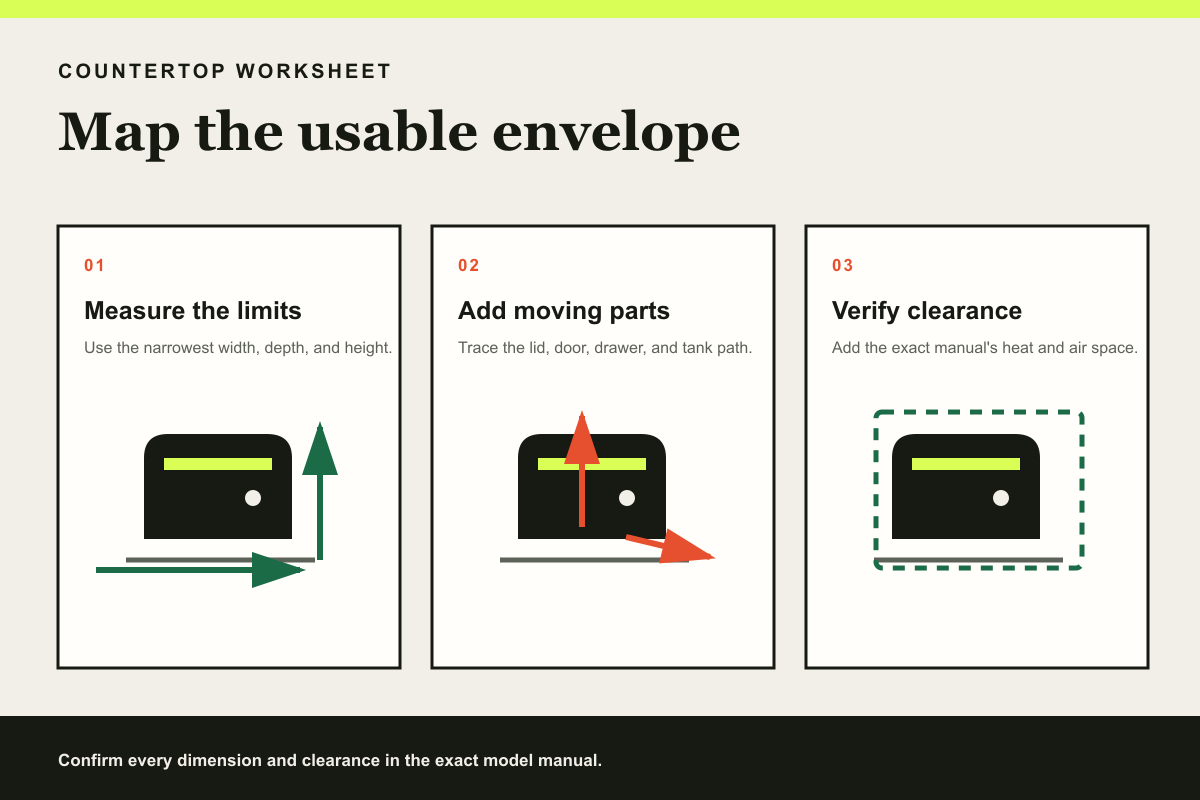
Product pages usually lead with an appliance’s closed width, height, and depth. Those numbers are necessary, but they do not describe the complete space the appliance needs. A lid may rise into an upper cabinet, a door may swing beyond the counter edge, or a water tank may need to lift straight up.
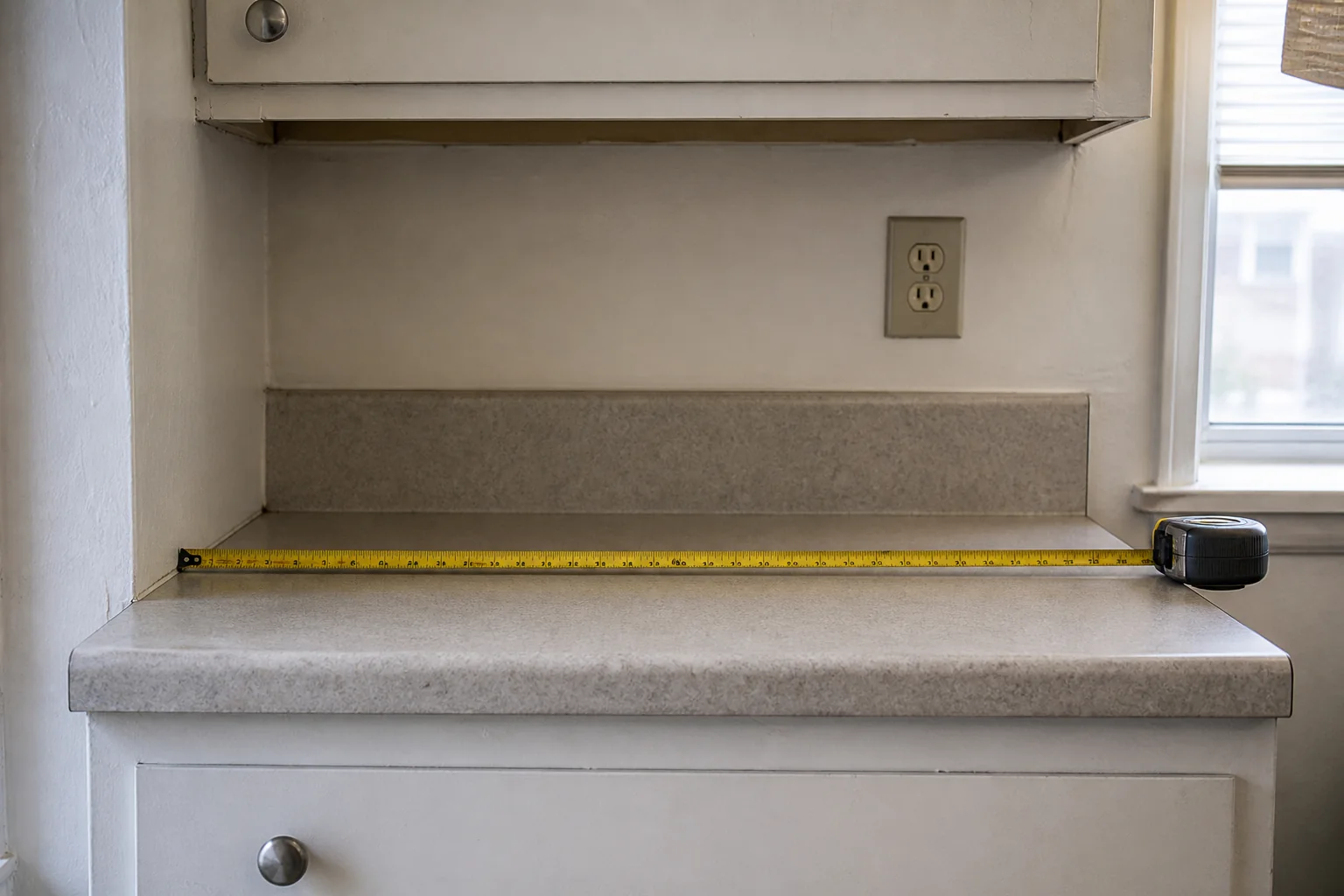
Create a three-dimensional usable envelope before comparing products. Record the narrowest width, the shallowest depth you can accept, and the lowest overhead point. Measure from the surfaces that will actually stop the appliance, including backsplash trim, outlet covers, cabinet lips, and wall molding.
- Width: the narrowest clear span, not the nominal cabinet width.
- Depth: wall or backsplash to the safe front limit of the counter.
- Height: counter surface to the lowest cabinet, shelf, or rail.
- Access: the extra path needed for lids, doors, drawers, baskets, and tanks.
Separate closed size from operating size
A compact appliance can fit while closed and still be awkward every day. Coffee makers often need room to raise a lid or remove a reservoir. Toaster ovens and microwaves need a usable door path. Food processors may need vertical space to remove a bowl or feed tube.
For each candidate, write down both the closed dimensions and the largest operating dimension. If the manufacturer does not publish the operating measurement, do not guess. Keep the candidate in a verify-before-buying group until the manual, diagram, or support team resolves it.
Treat required clearance as a separate measurement
Clearance is not a universal number. Heat, steam, ventilation, cord routing, and surrounding materials can change the requirement by model. The product manual or installation guide should be the primary source.
Do not turn a general rule from another appliance into a safety claim. Record the model-specific rear, side, and overhead clearances exactly as the manufacturer states them, then add those values to the physical dimensions before deciding that a product fits.
Test the daily routine on paper
A technically fitting appliance can still make the counter harder to use. Sketch the path for filling, loading, unloading, cleaning, and storing accessories. Note whether the appliance must be pulled forward, whether the cord still reaches safely, and where hot or wet parts will land.
The best fit is often the product that creates the least daily movement, not the product with the smallest headline footprint.
Real models to compare against the decision
These are reference models, not universal winners or a ranked list. Each exact listing is paired with source evidence; your use case and constraints still decide whether it belongs on the shortlist. Rule-out checks identify unresolved facts or incompatible conditions instead of inventing generic cons.
| Fit profile | Exact model | Measuring range | Published tool size | Power |
|---|---|---|---|---|
| Physical tape for short spaces | FastCap ProCarpenter Standard Reverse 16-foot tape measure | 16 ft physical tape | Not published on cited maker page | None |
| Laser measure for long spans | Bosch GLM100-23 BLAZE 100-foot laser measure | 6 in–100 ft laser range | 4 × 1.4 × 0.9 in | 2 AAA batteries |
| Two-in-one tape and laser | LEXIVON LX-201 2-in-1 digital laser tape measure | 16 ft tape / 130 ft laser | Not published on cited maker page | Battery powered; cell spec not published by maker |
A laser reading depends on its reference edge and a clear target surface. Use a physical tape for short recesses and recheck any dimension that decides whether an appliance clears a cabinet or moving part.
Best for: Counter depth, cabinet openings, and other short measurements where you can hook or brace a tape
FastCap ProCarpenter Standard Reverse 16-foot tape measure
A conventional tape remains the clearest option for shallow counters, cabinet interiors, and repeated checks at different points. The reverse markings can be read with the tape extended from either hand, while the erasable side pad gives you somewhere to record the smallest dimension.
Verified facts- FastCap identifies its ProCarpenter line as 16- and 25-foot tape measures with a one-inch blade on the standard models.
- The PSSR blade style prints standard measurements so they can be read when the tape is extended from either the right or left hand.
- The maker lists a dual locking system, erasable notepad, high-contrast tape, and a compact case among the line's features.
- The cited maker page covers the ProCarpenter series and does not publish the closed case dimensions for this exact 16-foot listing.
- A physical tape can bow across a long unsupported span; brace it against the surfaces that define the usable opening and repeat the measurement.
Paid link — I may earn a commission from a qualifying purchase. No price or rating is stored here.
Best for: Room width and long straight distances that are awkward to measure alone with a flexible tape
Bosch GLM100-23 BLAZE 100-foot laser measure
A compact laser measure can speed up room-width and long-counter checks when there is a clear target surface. It should supplement—not replace—the short physical measurements around backsplash trim, outlet covers, cabinet lips, and appliance moving parts.
Verified facts- Bosch publishes a measuring range of 6 inches to 100 feet for the GLM100-23.
- The official manual lists favorable-condition accuracy of ±1/16 inch and a lowest indication unit of 1/32 inch.
- Bosch publishes dimensions of 4 by 1.4 by 0.9 inches and specifies two AAA batteries.
- Accuracy depends on the target surface, background light, temperature, altitude, and the reference edge described in the manual.
- A laser line does not reveal a local obstruction or an out-of-square cabinet; recheck critical short dimensions with a physical tape.
Paid link — I may earn a commission from a qualifying purchase. No price or rating is stored here.
Best for: Keeping a 16-foot physical tape and a longer digital laser reading in one tool
LEXIVON LX-201 2-in-1 digital laser tape measure
The LX-201 combines an AutoLock physical tape for close work with a backlit laser display for longer spans. The two measuring modes are useful for different surfaces, but you still need to understand which edge each reading starts from before recording a final fit dimension.
Verified facts- LEXIVON identifies the exact LX-201 as a two-in-one measuring tool with a 16-foot AutoLock tape and a laser range up to 130 feet.
- The maker page lists a backlit LCD, one-button unit conversion, and feet, inch, fraction, meter, and millimeter readouts.
- The maker lists an automatic-off function and a belt clip.
- The cited maker page does not publish the closed body dimensions or battery-cell specification.
- Laser visibility and accuracy can vary with light and target conditions; use the physical tape and repeat any measurement that decides a tight fit.
Paid link — I may earn a commission from a qualifying purchase. No price or rating is stored here.
Interactive worksheet
Check the measurement envelope
Enter the available space, closed product dimensions, and the exact manufacturer clearance. This checks geometry only—not electrical, heat, ventilation, installation, or safety requirements.
3D fit preview
See the envelope, not just the numbers
Drag to rotate. Pinch or scroll to zoom.
- Available space
- Product body
- Body plus clearance
This is a proportional illustration. The labeled numeric result—not the camera angle—decides the fit.
Every entered dimension leaves non-negative space.
- Width
- +6.8 in
- Depth
- +0.2 in
- Height
- +2.5 in
Use the exact manual for model-specific clearances. A positive result here does not replace the manufacturer instructions or local requirements.
Before-you-buy checklist
- Measure width, depth, and height at more than one point and keep the smallest value.
- Include handles, knobs, plugs, backsplash trim, and cabinet lips.
- Record lid-open, door-open, drawer-open, and reservoir-removal space.
- Check the exact manual for ventilation and heat clearances.
- Plan filling, unloading, cleaning, and accessory storage.
- Recheck the current model and variant before ordering.
Sources and verification
Sources support the measurement method and examples above. Product-specific recommendations require a current manufacturer page or manual for that exact model.